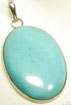
 For as long as people have called New Mexico home, they have pulled gems and minerals from its soil. Today, that tradition yields oil, gas, coal, uranium, and always, the gems that decorate our jewelry. Primary among those gems is a a hydrated phosphate of copper and aluminum known worldwide as turquoise.
For that part of the story, head with us to the hills of Cerrillos, south of Santa Fe, where a once-vibrant mining district held a special allure to famed jewelry company Tiffany’s. All because of a particular type of turquoise and that fabled Tiffany Blue box.
The Cerrillos mining district has seen activity since 600 A.D., first from Native peoples, then Spanish colonists and, later, American mining companies. But the history of turquoise mining wasn’t always a cherished one. From the Cerrillos Hills web site:
During the Spanish Period the pueblos continued to mine turquoise for their own use and trade with the unconquered tribes around New Mexico. The Spanish considered turquoise worthless and laughed at the Indians for mining it. Consequently, Spanish documents … ignore the continued mining of turquoise by the Indians. Only a few Spanish documents even mention the continued use of turquoise by the pueblos.
Late 1800s documents make references to Santo Domingo and Cochito Puebloans traveling to the Cerrillos Hills to collect turquoise. With the arrival of the railroad in 1881 and the development of tourism, travelers began snapping up Pueblo turquoise jewelry. A fad was being born.
In 1889, George F. Kunz, Tiffany & Co.’s renowned gemologist, won an award in Paris for a collection that contained a sample of New Mexico turquoise. In 1892, Kunz announced that certain colors of turquoise had come to be considered “gem quality” – namely, the Tiffany Blue color.
 According to a New York newspaper: That is a turquoise far and away the finest in America, and it came from these new mines in New Mexico. It is worth $4,000. … (I)t is probable that gems to the value of $200,000 a year may be obtained from this mine. Kunz recognized the possibilities of further branding the Tiffany Blue color by maintaining almost-exclusive rights to the turquoise he had made suddenly valuable.
That year, James P. McNulty came to Cerrillos to mine turquoise, eventually landing with the American Turquoise Company, which owned the claims to a number of mines. The ATC sold almost all of its turquoise directly to Tiffany & Co., where designer Pauling Farnham (regarded by some as “Tiffany’s lost genius”) crafted some $2 million worth of it into jewelry.
McNulty died Jan. 26, 1933, and is buried in the Masonic section of the old cemetery on Cerrillos Road in Santa Fe.
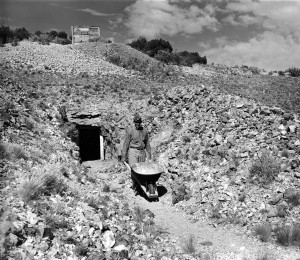
Herculano Montoya at the Tiffany mine(1937). Palace of the Governors Photo Archives
Today, the Tiffany Mine and with five other mines in Cerrillos are owned by Doug Magnus, a Santa Fe jewelry designer whose Santa Fe 400th line is available in the Spiegelberg Shop at the New Mexico History Museum.
Magnus says the mines are, in all likelihood, played out. Still, he was able to obtain several specimens of the raw ore “that had been hoarded for 80 or 100 years by the man that did all the mining for the American Turquoise Company.”
Despite such difficulties, Magnus said, turquoise seems to be enjoying new verve. “I’ve been working with it since 1972, and I’ve watched it become the single most popular semi-precious gemstone in the realm of semi-precious gemstones. And that’s worldwide.”
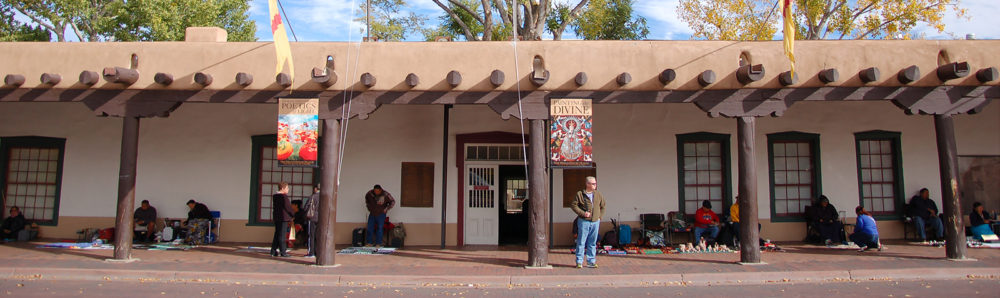
Magnus will talk about the mines and about the use of turquoise in jewelry-making at the 5th annual Palace of the Governors Gem & Mineral Show, 9 am-5 pm, June 18-20, in the Palace Courtyard. The event is free via entrance through the Blue Gate south of the History Museum’s main entrance at 113 Lincoln Avenue.
Miners, merchants and jewelers will display (and sell!) specimens ranging from raw ore to polished finery.
Guest speakers at the event:
Garrick Beck, “The History of Fakery in Gemstones,” 11 am Saturday
Beck’s Santa Fe company, Natural Stones, specializes in genuine, natural stones that are not dyed, synthesized, “stabilized” or “enhanced.
Doug Magnus,”The Cerrillos Mines,” 2 pm Saturday
Magnus, a Santa Fe jewelry designer whose Santa Fe 400th line is available in the Spiegelberg Shop at the New Mexico History Museum, has owned the six mines in Cerrillos, N.M., including the fabled Tiffany turquoise mine, since 1988.
Sandy Craig,”The Opals of Ethiopia,” 1 pm Sunday
Craig’s Orca Gems and Opals of Littleton, Colo., carries specimens, rough, rubs and cut stones from Nevada, Mexico, Honduras, Ethiopia, Lightning Ridge, Lambina, Mintabi, Yowah and Koroit.
 The Gem & Mineral Show, in conjunction with the Palace of the Governors Native American Artisan Program, allows gem and mineral dealers and Native American artisans to tell their unique stories about the historical relationships that have existed between Native silversmiths and jewelers, miners, and gem and mineral traders.
Exhibitors will include: Garrick Beck; Orca Gems and Opals; Roadrunner Mining and Minerals; Bright Star Gemstones; and Will Steerman.
Come to look, come to touch, come to buy, but most important, come to learn more about the historic interplay between miners, mineral traders and the artisans who bring life to these fruits of the earth.
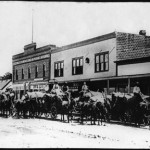 By the time Ernest Thompson Seton arrived in Clayton, N.M., in 1893 as a hired gun to kill wolves, nearly all the wolves were dead. Post-Civil War New Mexico had welcomed an influx of cattle ranchers and sport hunters who saw the gray wolf as a varmint, a nuisance, something easily expendable with poison, a bullet or a rope.
 He only had an hour, so Witt chose to focus on that pivotal year, beginning in 1893, when Seton brought his wolf-hunting skills to New Mexico: “At thirty-three, he almost certainly had more blood on his hands than anyone else in Clayton. None of it was human,” Witt writes in the book.
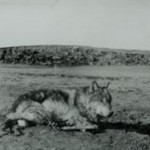 Wolf blood would yet be spilled before Seton’s great transformation would take place. The story of how Blanca and Lobo died is a difficult one, Witt acknowledged in his lecture. He described the manic, melancholy howling of Lobo after Blanca was killed. He took care to give the audience only brief glimpses of either wolf in their fatal traps (the black wolf “Lobo” in his trap, at left).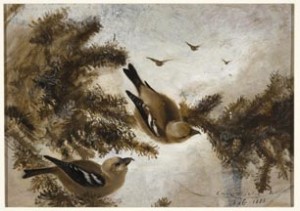


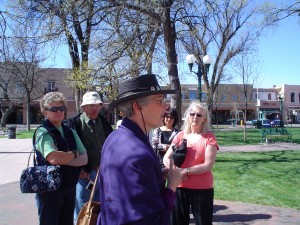 “The Italians did not have tomato sauce,” declared Pat Kuhlhoff. “The Swiss did not make chocolate. And there was never a potato famine in Ireland until Christopher Columbus discovered the Americas.”
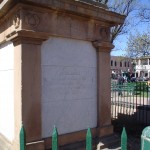 Standing in the Plaza, Kuhlhoff points to the obelisk commemorating those who died in the so-called Indian wars. She tells of how the word “savage” was chiseled out of its inscription –
 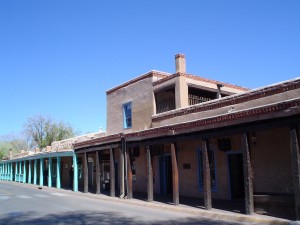 On the corner of Cathedral and Palace, she compares and contrasts Territorial, Pueblo, Mission and Romanesque architectural styles.
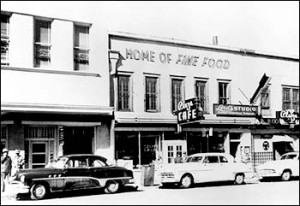 The
The  “The Cowden Café will be like a little café bistro,” said Daniel Razatos. “You come in for a little snack, nothing’s very huge or expensive, and it’s a nice, comfortable atmosphere to hang out and read your newspaper – very European.”
 That campaign just won honors from the
 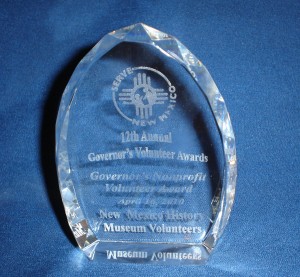 Last week, the New Mexico History Museum’s many volunteers were honored with a prestigious award by the
 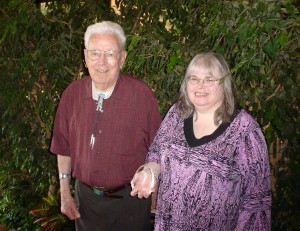 John Ramsay accepted a last-minute invitation from Patricia to attend the event and said it was just another never-know-what-to-expect day in the life of a volunteer. For the last 14 years, Ramsay has volunteered at the History Library, most of that time “in the bowels” of archived documents. While helping with cataloguing and such, he’s honed an interest in Southwest history deep enough to lead him to contribute a chapter to a book that will be published by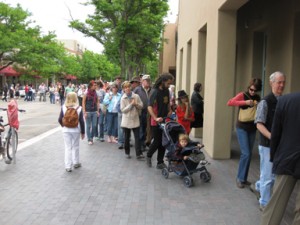
 Also in the magazine is an article noting 25 kid-friendly museums, and it names the Native American Artisans Portal Program (left) at the Palace of the Governors.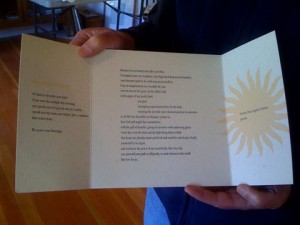
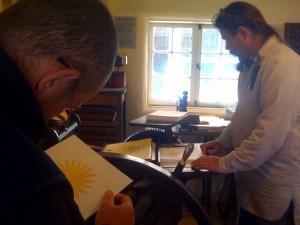
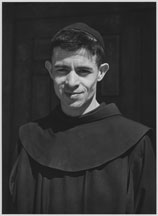 The beauty of that culture was threaded throughout Chávez’s life. Born Manuel Ezequiel Chávez in Wagon Mound, N.M., Fray Angélico was ordained as a Franciscan, served several parishes in New Mexico and was instrumental in renovating the church in Peña Blanca – a true hands-on effort. The murals he painted of the Stations of the Cross used images of himself, his family and parishioners. He also renovated churches in Domingo Station, Golden and Cerrillos.
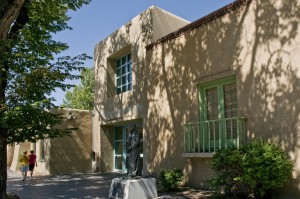 After his death in 1996, the History Library was named in his honor, and a bronze statue of him graces its entrance. A self-portrait is on display in the Palace of the Governors’ Portrait Gallery, and it carries an interesting tale. Painted in 1939 as an “idle sketch” on a board by Fray Angélico in 1939, it was later trimmed down to repair a drawer in the convent at Peña Blanca. In 1970, someone cleaning out the drawers happened upon it. Fray Angélico donated it to the museum, writing: “I thought you might display it more as a curiosity than a work of art.”
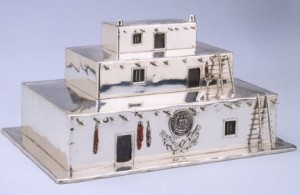 The New Mexico History Museum holds the set and has several of its pieces on display in its core exhibition, Telling New Mexico: Stories from Then and Now. Each piece was handcrafted to reflect different aspects of the state’s cultural heritage – Coronado’s Expedition 1540-42; San Miguel Chapel – Oldest Church in the US; and the First Locomotive through Raton Pass – 1879. Pretty much everyone’s favorite piece is a humidor in the shape of Taos Pueblo. (That’s it at left and, if you know which viga to press on, you can pop open the various floors of the “pueblo.”)